On 19 January 2026, two changes to UK gambling promotions took effect. First, wagering requirements on bonuses are capped at 10 times. Second, promotions that mix products are banned: for example, a sports bet that unlocks casino spins. Both came from the Gambling Commission's review of incentives, and both apply to every operator it licenses. This guide covers what changed, what didn't, and how to read a bonus offer under the new rules.
On this page6 sections
Change 1: the 10x wagering cap
A wagering requirement is the number of times bonus funds, or the winnings from free spins, must be staked before they can be withdrawn. Before the cap, no limit applied, and multiples of several dozen times were allowed. Under the new rule, the requirement can't exceed 10 times.
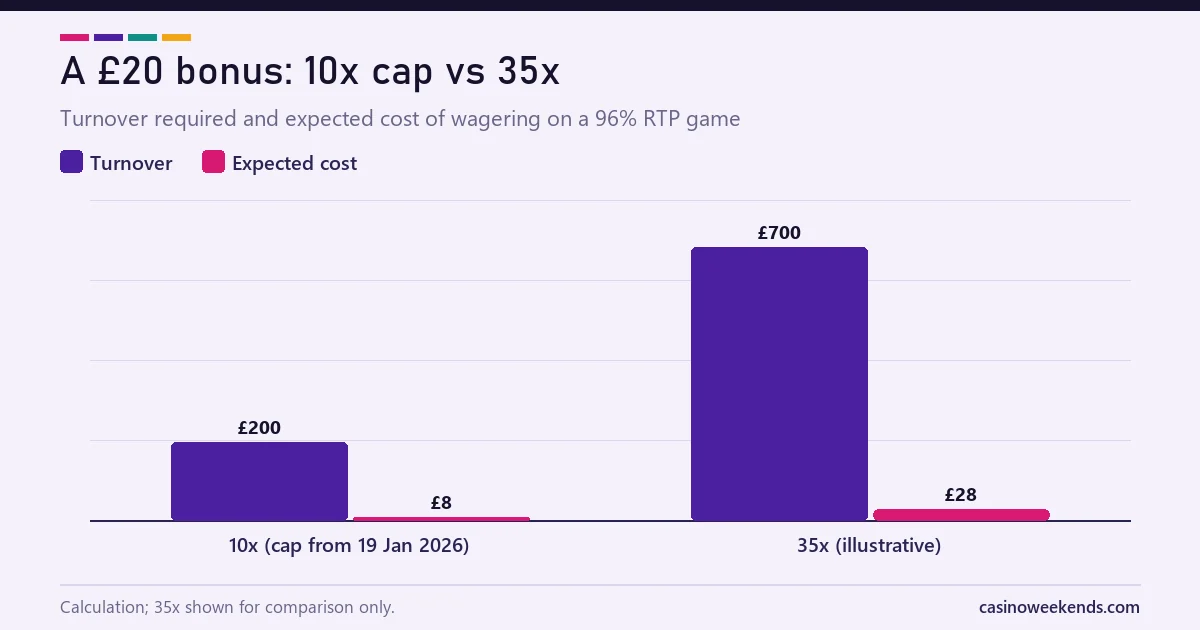
The cap matters because the cost of wagering grows in line with the multiple. Every pound staked loses, on average, the game's house edge. On a 96% RTP slot that is 4p per pound:
| £20 bonus, 96% RTP | Turnover required | Expected cost of wagering | Expected value left |
|---|---|---|---|
| 10x (the cap) | £200 | £8 | about £12 |
| 35x (illustrative pre-cap offer) | £700 | £28 | about £0 |
At 35 times, the expected cost of wagering was larger than the bonus itself. Most players lost the bonus before the requirement was met. At 10 times, an average player keeps a good part of it. The same arithmetic applied to free spins is worked through in what free spins are really worth.
Change 2: no mixed-product promotions
Offers that require play on one product to unlock a reward on another are now banned. Examples are "bet £10 on football, get 50 casino spins" and "play bingo, unlock a sports free bet". Each promotion now has to stay within one product: casino rewards for casino play, betting rewards for betting. An offer can no longer use one product to draw a customer into another.
What did not change
- Other bonus terms still apply. Maximum bet while wagering, game weighting, expiry and win caps are not covered by the 10x rule. A bonus with a short expiry or a low win cap can still be worth little.
- Offers without wagering are unaffected. They were already below the cap.
- Stake limits and game design rules sit alongside the cap: £5 per slot game cycle (£2 for 18–24s) and a minimum 2.5-second cycle. See the stake limit and the 2.5-second rule.
How to read a bonus now
- Find the multiple and what it applies to. "10x the bonus" and "10x the free-spin winnings" are both within the cap.
- Work out the turnover. Multiple × bonus amount.
- Multiply by the house edge of the games you'll play. 4% for a 96% slot, more for a lower RTP. That is the expected cost.
- Subtract it from the bonus and compare with the win cap and expiry. What is left is a fair estimate of the offer's worth.
A £50 bonus at 10x on a 96% slot: £500 turnover, £20 expected cost, about £30 expected value. If the win cap is £100, it barely bites. If expiry is 24 hours, ask whether £500 of play in a day suits you.
Current UK offers are compared on our casino bonuses page, and offers with no wagering at all are on no-wagering bonuses.
Key points
- From 19 January 2026, UK bonus wagering requirements can't exceed 10 times.
- Promotions that link two products, such as betting and casino, are banned.
- Expected cost of wagering = turnover × house edge. At 10x on a 96% game, that is 40% of the bonus.
- Win caps, expiry and maximum bet rules still apply and still matter.
Sources
- Gambling Commission, Socially responsible incentives: consultation response, executive summary.