Online bingo tickets show a running counter: 3TG, 2TG, 1TG, the numbers still needed to finish. Lobbies sort tickets by it, chat rooms celebrate it, and "1TG" sounds like a prize is close. How close it really is depends on one thing the counter doesn't show: how many balls are still left in the drum.
On this page6 sections
1TG: one number, k balls left
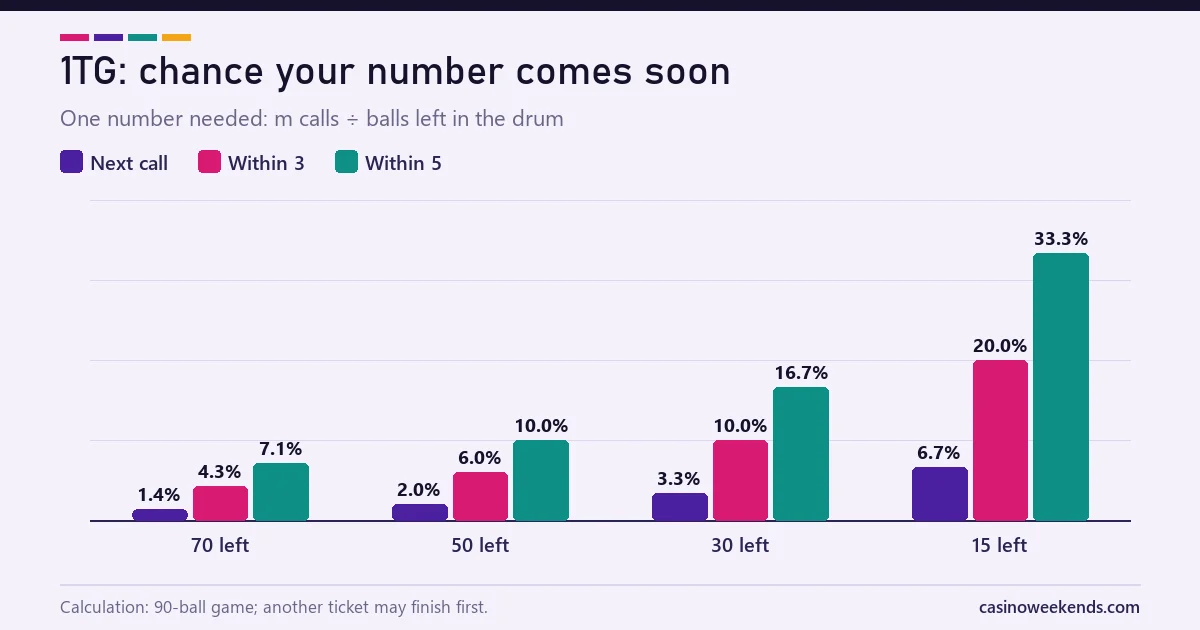
If your ticket needs one number and k balls have not been called yet, every remaining ball is equally likely to come next. The chance that the next call is yours is 1 in k. The chance that it comes within the next m calls is m in k.
| Balls left in the drum | Next call | Within 3 calls | Within 5 calls |
|---|---|---|---|
| 70 (20 called) | 1.4% | 4.3% | 7.1% |
| 50 (40 called) | 2.0% | 6.0% | 10.0% |
| 30 (60 called) | 3.3% | 10.0% | 16.7% |
| 15 (75 called) | 6.7% | 20.0% | 33.3% |
Early in a 90-ball game, a 1TG ticket has only about a 1 in 70 chance on the next call. A one-line 1TG at call 20 is close in the sense of "one number", but the drum is still mostly full. Late in the game a 1TG is a real prospect: a one-in-three chance within five calls when 15 balls remain.
2TG: two numbers
For two specific numbers to both come out within the next m calls from k balls left, the chance is m(m − 1) ÷ (k(k − 1)). It's much lower than twice the 1TG figure:
| Point in a 90-ball game | Within 2 calls | Within 5 calls | Within 10 calls |
|---|---|---|---|
| 60 called (30 left) | 0.23% | 2.30% | 10.34% |
| 75 called (15 left) | 0.95% | 9.52% | 42.86% |
A 2TG ticket at call 60 has about a 1 in 10 chance of finishing within ten more calls, if the game lasts that long.
The catch: the game doesn't wait for you
These figures are the chance that your numbers come out. They aren't your chance of winning the prize. In a busy room, other tickets are also 1TG and 2TG, and the game ends the moment any of them finishes. With hundreds of tickets in play, a full house usually lands in the low sixties (see our strip-of-six guide for the simulation). So a ticket that is 2TG at call 60 rarely gets its ten calls.
That is why the counter mostly works as a mood indicator. Being 1TG on many tickets at once is common in big rooms, and so is losing to someone else's 1TG on the very next call. The only thing that sets your long-run share of wins is your share of the tickets in play.
Does the counter mean anything for buying?
No. Tickets are bought before the game starts and can't be added once it is running. The counter can't be used to time a purchase. What it can do is make the game feel more winnable than it is, which is worth knowing when a session runs longer than planned.
Same idea in 75-ball and 80-ball
The formula is the same in every format. Only the drum size changes. A 1TG in 75-ball with 25 balls left has a 1 in 25 chance on the next call. In 80-ball with 40 left it is 1 in 40. The format comparison shows how long each game usually runs.
Key points
- A 1TG ticket's chance on the next call is 1 divided by the balls left.
- For a 2TG ticket the chance falls sharply: two numbers within five calls from 30 left is 2.3%.
- In a busy room, another ticket usually finishes first. The counter is about your numbers, not about the prize.
Our bingo sites page lists UK rooms by game type and ticket price.