Two casinos can offer the same slot, with the same graphics, paylines and features, and still pay back different amounts on average. Many game studios supply a title in several return-to-player (RTP) settings, and each casino picks the one it runs. The difference doesn't show on the reels. It does show in the rules screen, and over a session it shows in your balance.
On this page6 sections
What RTP is, and what it is not
RTP is the share of all money staked on a game that it pays back over the very long run. A 96% slot returns £96 for every £100 staked, averaged over millions of game cycles. The other 4% is the house edge. RTP says nothing about one session. Volatility decides how wildly a session swings. RTP decides what the average swing costs.
Why one game has several settings
A studio can build the same game with different payout tables or feature frequencies, and so with different RTPs, while the look and the rules stay the same. Casinos choose a version based on their business. The setting can also differ between a casino's markets. It is fixed in the version a casino runs, not adjusted from spin to spin. A setting is a product choice, not a hidden trick. But it is easy to miss, because the game looks identical everywhere.
Where to find the figure
- Open the game and look for the information button: often an "i", a question mark or a menu icon.
- Go to the rules, help or paytable section. The RTP is usually listed near the end, as "theoretical return to player" or "expected payback".
- Note whether there is more than one figure. Some games list a base-game RTP and a different figure for a bought feature, or a range.
- Check the same title at another casino if you are comparing. The figures should be in the same place.
An RTP listed on a review site, including this one, applies to the version that site looked at. The figure in the game you are about to play is the only one that counts.
What the gap costs
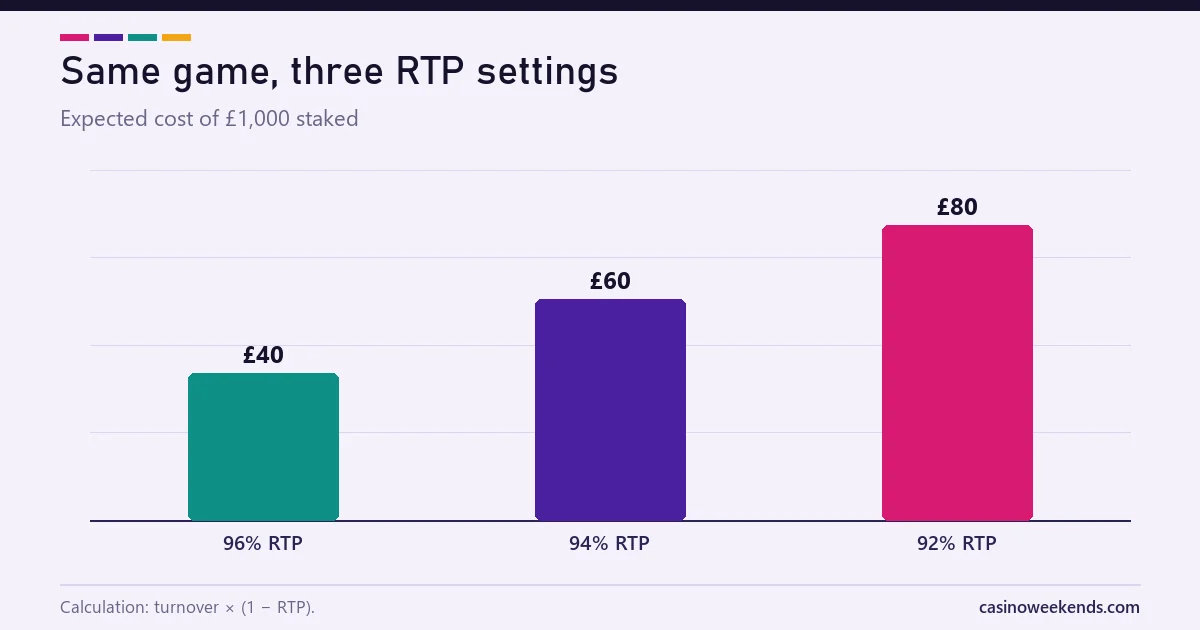
The expected cost of play is turnover × house edge. Per £1,000 staked:
| RTP setting | House edge | Expected cost per £1,000 staked |
|---|---|---|
| 96% | 4% | £40 |
| 94% | 6% | £60 |
| 92% | 8% | £80 |
£1,000 of turnover is less than it sounds. At £1 a spin, a UK slot can turn over £1,440 an hour at the fastest pace allowed, as shown in the 2.5-second rule. A 92% version of a game costs twice as much per hour on average as the 96% version: the house edge is double.
RTP and bonuses
RTP matters most when you are clearing wagering. A free-spin offer tied to one game is worth much less if that game runs a low setting. With 10x wagering, a 96% game keeps about 60% of expected winnings, while a 94% game keeps about 40%. The full calculation is in what free spins are really worth, and the UK cap on wagering is covered in the 10x rule.
Key points
- The same slot title can run at different RTP settings at different casinos.
- The figure is in the game's rules, help or paytable screen. Check it in the game itself.
- Each two points of RTP add £20 per £1,000 staked to the expected cost.
- For bonus wagering, the RTP of the game you play sets the cost of clearing it.
UK slot sites are compared on our slot sites page, and game studios on the software providers page.