Since 31 October 2021, an online slot offered in Great Britain may not complete a game cycle faster than every 2.5 seconds. The rule is part of the Gambling Commission's game design rules, which also banned autoplay and the "turbo" and "slam stop" features that sped up play. The rule is usually discussed as a safety measure. It also gives you a hard number for working out what a session can cost.
On this page6 sections
From 2.5 seconds to an hourly ceiling
One hour is 3,600 seconds. At one cycle per 2.5 seconds, that is at most 1,440 game cycles per hour. Real play is slower: people pause, games run longer animations, bonus rounds take time. But 1,440 is the most the rules allow, and it is the right figure for a worst-case budget.
Turnover per hour
Turnover is the total amount staked. At the maximum pace:
| Stake per cycle | Turnover per hour |
|---|---|
| £0.10 | £144 |
| £0.50 | £720 |
| £1 | £1,440 |
| £2 (cap for ages 18–24) | £2,880 |
| £5 (cap for 25 and over) | £7,200 |
Turnover is not the amount you lose. Most stakes come back as wins and get staked again. It is, however, the amount the game's house edge is applied to.
Expected loss per hour
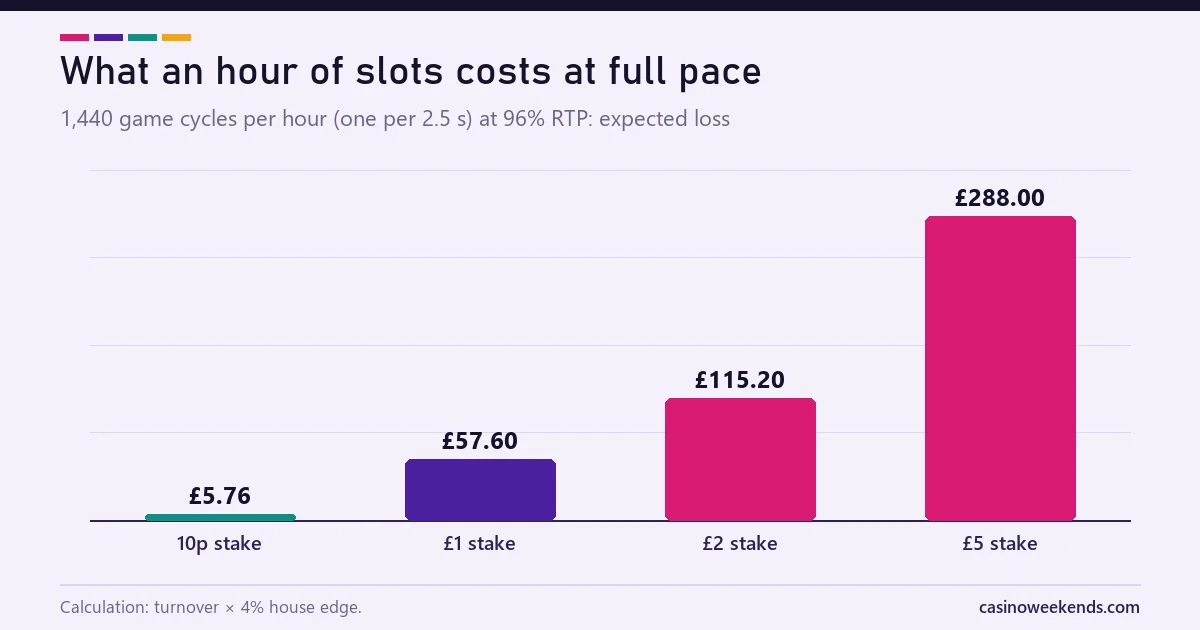
A slot's return to player (RTP) is the long-run share of turnover paid back. The rest is the house edge. Expected loss per hour = turnover × (1 − RTP):
| Stake | RTP 97% | RTP 96% | RTP 94% |
|---|---|---|---|
| £0.10 | £4.32 | £5.76 | £8.64 |
| £1 | £43.20 | £57.60 | £86.40 |
| £2 | £86.40 | £115.20 | £172.80 |
| £5 | £216.00 | £288.00 | £432.00 |
Two readings matter. First, the RTP gap is worth real money. At £1 a cycle, a 94% game costs £29 an hour more on average than a 96% game. The same title can be offered at different RTP settings, so check the version you are playing. Our guide to finding a slot's RTP shows where. Second, the expected loss is an average. A single hour can go far above or below it. High-volatility slots swing more, but the average cost is the same.
What else the game design rules changed
- No autoplay. Each cycle must be started by the player.
- No turbo or slam stop. Features that make a cycle faster, or let the reels be stopped early to see the result sooner, are banned.
- No celebrating losses as wins. A return equal to or below the stake can't be shown with the sounds and visuals of a win.
- Net position and time on screen. The game shows how much you are up or down and how long the session has run.
Since 2025 there is also a stake limit of £5 per cycle (£2 for 18–24s). Together with the 2.5-second minimum, this puts a firm ceiling on turnover per hour.
Using the numbers
A simple rule of thumb from the table: at 96% RTP and full pace, a session costs on average about 58 times the stake per hour, because 1,440 × 4% = 57.6. At 10p that is under £6. At £1 it is nearly £58. Setting a deposit limit around that figure turns an abstract RTP into a budget. A limit can be lowered at once at UK sites, and raising it takes at least 24 hours. See the cooling-off rule.
Compare UK slot sites on our slot sites page.
Sources
- Mishcon de Reya, Gambling Commission announces strict new measures for online games.
- Gambling Commission, Online slots stake limit guidance.