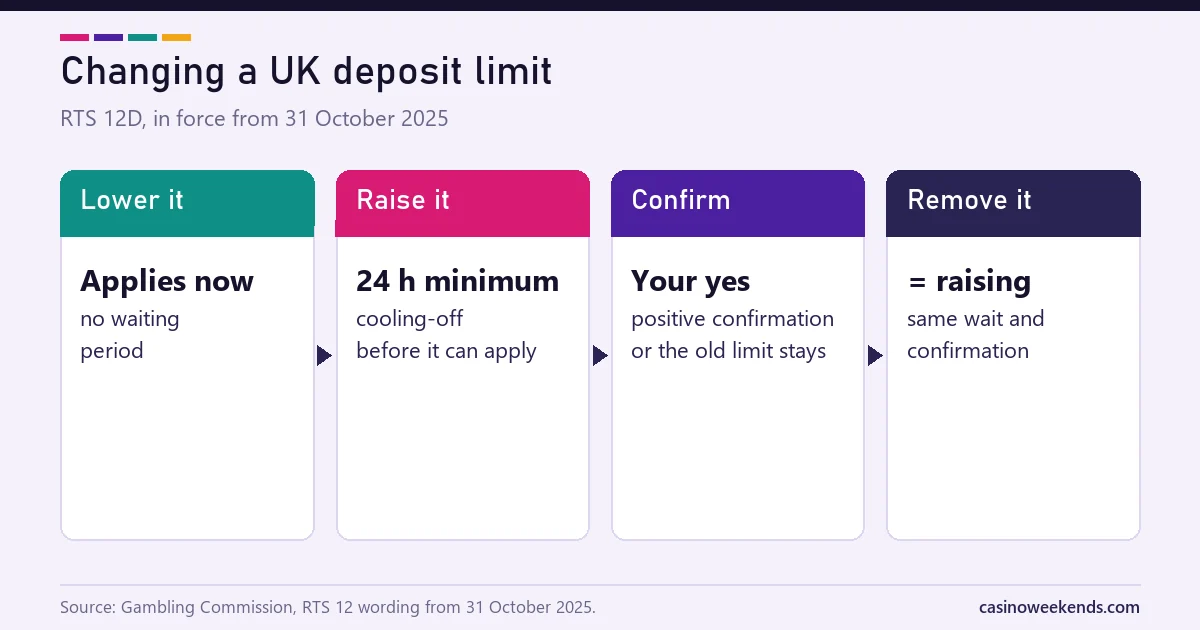
Every UK-licensed gambling site lets you set a deposit limit: a cap on how much you can pay in per day, week or month. Since 31 October 2025, the rules on changing that limit are tighter, and they work in one direction only. A lower limit can apply immediately. A higher one can't apply until at least 24 hours have passed and you have confirmed you still want it.
On this page6 sections
The rule in plain terms
The requirement sits in the Gambling Commission's remote technical standards, as RTS 12D. Under the wording in force from 31 October 2025:
- Decreasing a limit takes effect as soon as it is set.
- Increasing a limit takes effect only after a cooling-off period of at least 24 hours, and only after you give a positive confirmation that you want it.
- Removing a limit is treated as an increase, so the same delay and confirmation apply.
"Positive confirmation" means you have to actively confirm the change, for example by returning to the account and pressing a button. The higher limit doesn't switch on by itself when the 24 hours are up. If you never confirm, the old, lower limit stays.
Why the asymmetry
A limit is a decision made in advance, while you are not in the middle of a session. The rule makes it easy to tighten that decision at any time and slow to loosen it. The 24 hours put a night's sleep between the urge to raise a limit and the higher limit taking effect. The confirmation step means the change has to be chosen twice.
Setting a limit that works
A limit works best when it is based on what play actually costs, not on a round number. Two ways to size it:
- From a budget. Decide what a month of entertainment is worth to you and set the monthly limit there. Daily or weekly limits can sit beneath it.
- From the arithmetic of the game. At 96% RTP and the fastest pace allowed in the UK, an hour of slots at £1 a spin costs about £58 on average. At 10p it is under £6. The full table is in the 2.5-second rule. A weekly limit of a few hours at your usual stake is a realistic figure.
Limits apply per operator. If you hold accounts at several sites, each needs its own limit. Payment methods with built-in spending controls, such as the gambling block many UK banks offer on debit cards, work across all sites at once. Our payment methods guide covers them.
How it fits with other UK rules
- Stake limits: £5 per online slot game cycle, £2 for ages 18–24. See stake limits.
- Credit cards: gambling with a credit card has been banned since 14 April 2020, including through e-wallets funded by a credit card. See the credit card ban.
- Bonuses: wagering capped at 10x since 19 January 2026. See the 10x cap.
Key points
- Since 31 October 2025, a lower deposit limit applies immediately at UK-licensed sites.
- A higher limit waits at least 24 hours and must then be positively confirmed.
- Removing a limit counts as raising it.
- Limits are per site. Bank gambling blocks work across all of them.
If gambling is no longer fun, free and confidential support is available from the National Gambling Helpline on 0808 8020 133.
Sources
- Gambling Commission, Annex 2: RTS 12 wording in full from 31 October 2025.