"Buy more tickets, win more often" is true, and it is the reason bingo lobbies show ticket counts and auto-buy buttons. What extra tickets don't do is change what each pound returns on average. That depends on how the prize is funded, not on how many tickets you hold. There is one exception, and it is the one case where the arithmetic of bingo can briefly favour the player.
On this page5 sections
Your share of the room
Every ticket in a bingo game has the same chance of winning. If 400 tickets are in play and you hold 20, you hold 5% of the tickets. Over many games you will win about 5% of the prizes. If you buy 40 tickets and the rest of the room stays the same, you hold about 9.5% and win about 9.5% of the prizes, at twice the cost.
So the chance of winning grows with tickets. The cost grows at the same rate. What you get back per pound depends only on the size of the prizes compared with what everybody pays.
Percentage games: the return is the payout rate
Many bingo games fund the prizes as a share of ticket sales, for example "80% of ticket sales paid out in prizes". In that game:
- the room's total prize money is 80% of what all players paid;
- your share of that prize money, on average, equals your share of tickets;
- so for every £1 you spend, you get back 80p on average, whether you bought one ticket or a hundred.
| Your tickets (10p each), room 1,000 tickets | You pay | Your share | Average prize return at 80% |
|---|---|---|---|
| 6 | £0.60 | 0.6% | £0.48 |
| 24 | £2.40 | 2.4% | £1.92 |
| 96 | £9.60 | 9.6% | £7.68 |
Heavier buying makes your results less volatile. You win more often and in smaller steps relative to your spend. It does not make the game cheaper.
Guaranteed games: when the arithmetic turns
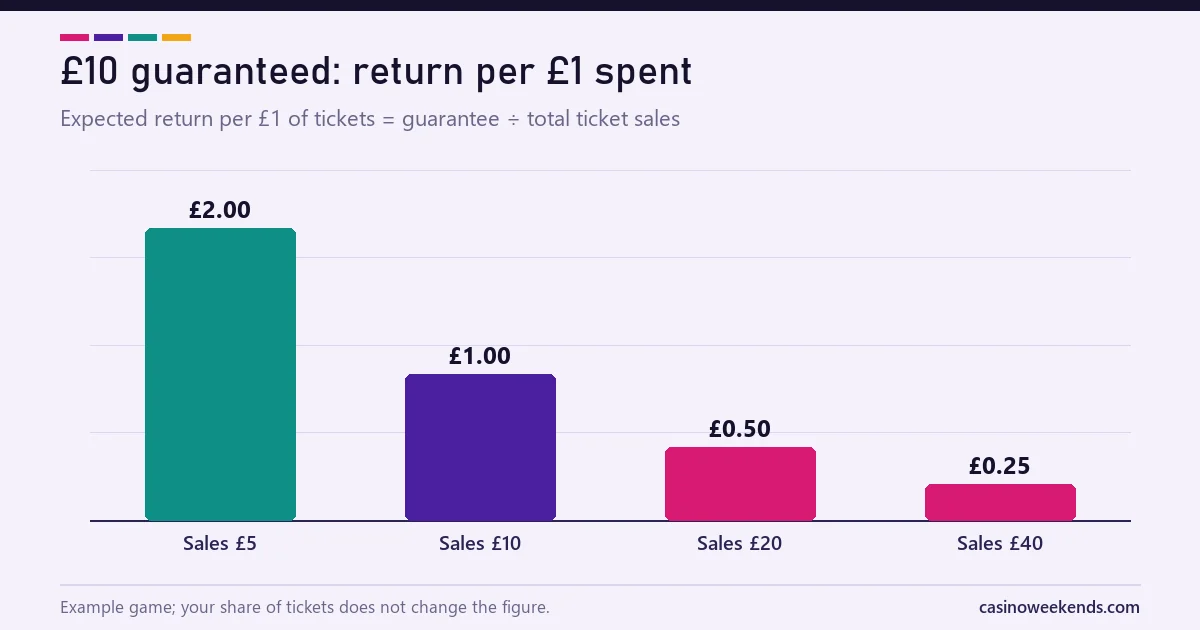
Some games advertise a guaranteed prize: "£10 full house guaranteed". The prize is paid whatever the ticket sales are. That breaks the link between what players pay and what is paid out:
| Guaranteed prize | Total ticket sales | Average return per £1 spent |
|---|---|---|
| £10 | £5 | £2.00 |
| £10 | £10 | £1.00 |
| £10 | £20 | £0.50 |
| £10 | £40 | £0.25 |
When a guaranteed game is under-sold, the room as a whole gets back more than it paid. This is why quiet rooms at quiet hours draw regular players who look at the ticket counter before buying. In that situation, each extra ticket you buy still adds to sales, and so pulls the return per pound down. The best return per pound always goes to whoever holds a few tickets in an empty room.
Two cautions. Ticket counters can move until the last second before the game starts. And many lobbies cap tickets per player, or show the prize as "up to" a figure instead of guaranteeing it. Read the game card. A guarantee is only a guarantee if the game card says so.
Free tickets and penny games
Free bingo and 1p games follow the same logic. With free tickets your cost is zero, so any prize is pure gain. Free-ticket prizes often come as bonus funds with wagering attached, though. What those are really worth is covered in our free spins value calculation. The method carries straight over to bingo bonus money. Since 19 January 2026 the wagering on such bonuses is capped at 10 times for UK licensed operators. See the 10x cap.
Key points
- Your share of prizes over time equals your share of tickets in play.
- In a percentage game, the average return per £1 is the payout rate, however many tickets you buy.
- A guaranteed prize in an under-sold game can return more than the tickets cost. Extra tickets dilute that.
- More tickets means more frequent wins and the same average cost per pound.
Compare rooms and their game types on our bingo sites page, or read how a 90-ball strip of six spreads your tickets across the drum.