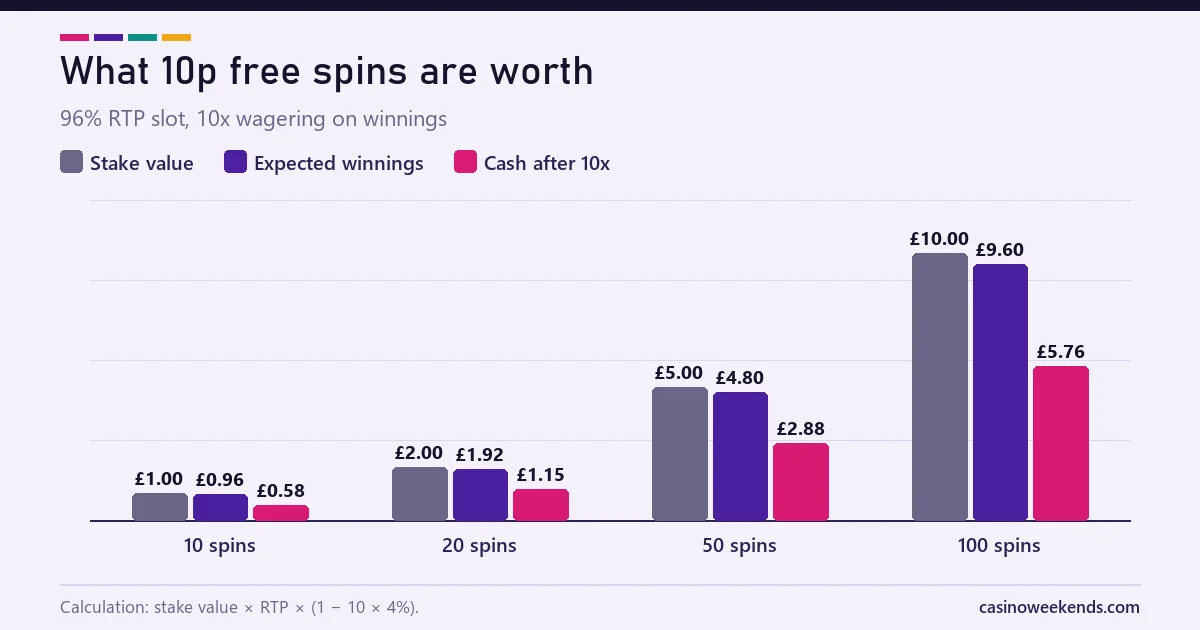
"100 free spins" sounds like £10 of play at 10p a spin. What it is worth in cash you can withdraw is a different, smaller number. It depends on four things: spin value, the slot's RTP, the wagering on any winnings, and the win cap. Here is the calculation, worked through so you can apply it to any offer.
On this page7 sections
Step 1: the stake value
Multiply the number of spins by the value of each spin. 100 spins at 10p = £10 of stakes. This is the figure promotions lead with. It is what the spins would cost you if you paid for them, not what they are worth.
Step 2: expected winnings
A slot returns, on average, its RTP times what is staked. On a 96% slot, £10 of spins is expected to produce £9.60 of winnings. Some sessions produce nothing, some produce much more. £9.60 is the long-run average per £10 of free spins.
If the winnings are paid as cash with no wagering, that is the value of the offer: stake value × RTP. No-wagering spins at 10p on a 96% game are worth about 9.6p each.
Step 3: wagering on the winnings
Most free-spin winnings arrive as bonus funds that must be wagered a number of times before they can be withdrawn. Every pound wagered loses, on average, the house edge (1 − RTP). With winnings W, a wagering multiple x and a house edge h, the expected cost of clearing the wagering is W × x × h. A standard approximation of what is left:
Cash value ≈ stake value × RTP × (1 − x × h)
At 96% RTP (h = 4%) and 10x wagering, the factor is 1 − 10 × 0.04 = 0.6:
| Spins at 10p | Stake value | Expected winnings | Cash value after 10x |
|---|---|---|---|
| 10 | £1.00 | £0.96 | £0.58 |
| 20 | £2.00 | £1.92 | £1.15 |
| 50 | £5.00 | £4.80 | £2.88 |
| 100 | £10.00 | £9.60 | £5.76 |
So 100 "free" 10p spins with 10x wagering are worth about £5.76 on average, a little over half the headline stake value.
Why the multiple matters so much
The factor 1 − x × h falls quickly as the multiple rises:
| Wagering on winnings | Share of expected winnings kept (96% RTP) |
|---|---|
| None | 100% |
| 5x | 80% |
| 10x | 60% |
| 20x | 20% |
| 25x and above | about 0% |
At 25 times and above, the simple formula reaches zero. In practice the value isn't exactly zero, because a lucky early win can clear the wagering. But most of the time the balance is lost before the requirement is met. This is why the UK's 10x cap on wagering, in force since 19 January 2026, changed the arithmetic of bonuses so much. See the new UK bonus rules.
Step 4: the win cap and other terms
- Maximum win. Many free-spin offers cap the winnings that can be converted, for example "max £50". On small spin bundles the cap rarely bites. On a high-volatility slot it removes the rare large wins that make up part of the average, so the true value is a little below the formula.
- RTP of the named game. Spins are usually tied to one slot. Its RTP setting at that casino decides h. A 94% version has a 6% edge, and 10x wagering then keeps only 40% of expected winnings. Our guide to finding a slot's RTP shows where to check.
- Expiry. Spins and bonus funds often expire within days. An unused offer is worth nothing.
- Game weighting. If you clear wagering on games that count less than 100%, more turnover is needed, so the cost goes up.
Comparing two offers
Offer A: 50 spins at 20p, no wagering, 96% slot. That is £10 × 0.96 = £9.60.
Offer B: 100 spins at 10p, 10x wagering, 96% slot. That is £10 × 0.96 × 0.6 = £5.76.
Same headline stake value, very different worth. The formula takes a minute and compares any two offers fairly. Current spin offers are listed on our free spins and low-wager free spins pages.
Key points
- Stake value is what the spins would cost. Expected winnings = stake value × RTP.
- Cash value after wagering ≈ stake value × RTP × (1 − wagering × house edge).
- At 96% RTP, 10x wagering keeps about 60% of expected winnings, 20x about 20%.
- Win caps, expiry and the game's RTP setting all push the true value down.
These are long-run averages. Any single bundle of spins can pay far more or nothing at all.