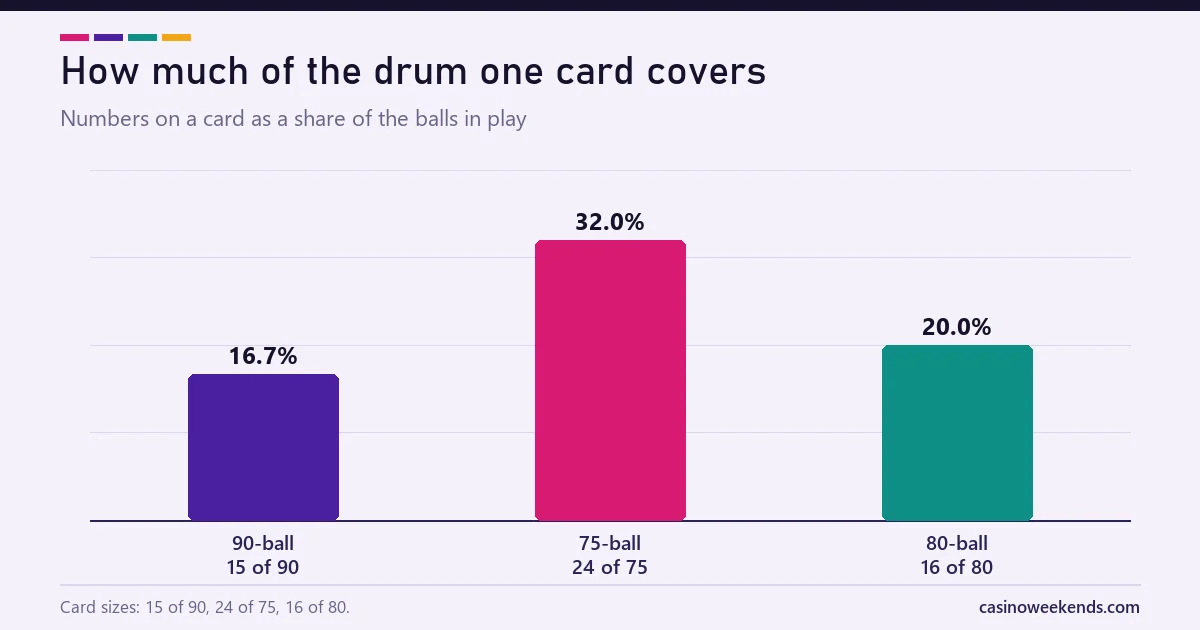
Online bingo lobbies in the UK usually offer three formats next to each other: the 90-ball game that British and Irish halls are built on, the American 75-ball game and the shorter 80-ball game. They look similar on screen. They play quite differently, because the card, the patterns and the length of the game all change. Here is the side-by-side comparison.
On this page5 sections
The cards
| 90-ball | 75-ball | 80-ball | |
|---|---|---|---|
| Grid | 3 rows × 9 columns | 5 × 5 | 4 × 4 |
| Numbers on a card | 15 | 24 + free centre | 16 |
| Columns | by tens: 1–9, 10–19 … 80–90 | B 1–15, I 16–30, N 31–45, G 46–60, O 61–75 | 1–20, 21–40, 41–60, 61–80 |
| Share of the drum on one card | 16.7% | 32% | 20% |
| Usual prizes | one line, two lines, full house | a set pattern, often a blackout | line, corners, pattern, full card |
The 90-ball ticket is mostly blanks: 15 numbers in 27 squares. The 75-ball card is almost all numbers, with only the centre square free. The 80-ball card is a small, full grid of 16.
Patterns
90-ball uses fixed prizes. A line is any complete horizontal row, two lines are any two rows on the same ticket, and the full house is all 15 numbers.
75-ball is a pattern game. Before each game the room shows a shape: a letter, a frame, a cross, four corners, or a blackout (every number on the card). Any card that completes that shape wins. The pattern decides how long a game lasts. A four-corners game can end within a dozen calls, while a blackout takes most of the drum.
80-ball sits between them. Typical prizes are a row or column, the four corners, a square in the middle and the full card. The exact set varies by room.
How many calls each game takes
The length of the game for the full-card prize follows straight from the card size. Here is the exact chance that one card is complete by a given call:
| Game, full card | By call 50 | By call 55 | By call 60 | By call 65 |
|---|---|---|---|---|
| 90-ball full house (15 of 90) | 0.0049% | 0.026% | 0.116% | 0.453% |
| 80-ball full card (16 of 80) | 0.018% | – | 0.555% | – |
| 75-ball blackout (24 of 75) | – | 0.0097% | 0.14% | 1.54% |
The 75-ball blackout needs a lot of numbers (24) but draws from a smaller drum. So it is slower than the 90-ball full house early on and catches up late. The 80-ball full card has nearly the same number count as the 90-ball ticket and a smaller drum, so it finishes earlier. In a busy room the game ends when the fastest card finishes, which is usually much earlier than any single card's average. The call-limit jackpot guide covers how a room's numbers change this.
Which game suits what
- 90-ball gives three chances to win in one game, and with a strip of six every call is on your tickets. It is the longest, most social game and the default in UK rooms.
- 75-ball changes with each pattern. Short patterns make quick games with small prizes. Blackouts are long games, often with a jackpot.
- 80-ball is the quickest of the three to a full card. It suits short sessions.
In all three formats, your share of the prizes over time is your share of the tickets in play, and the room's payout percentage sets the expected return. That doesn't change between formats. See your share of the room for the arithmetic.
Reading the to-go counter
All three formats show how many numbers each card still needs: the 1TG, 2TG and so on. The meaning is the same in each, but the odds that the next call finishes you depend on how many balls are left in the drum. Our 1TG and 2TG guide has the figures.
Rooms offering each format are compared on our bingo sites page.