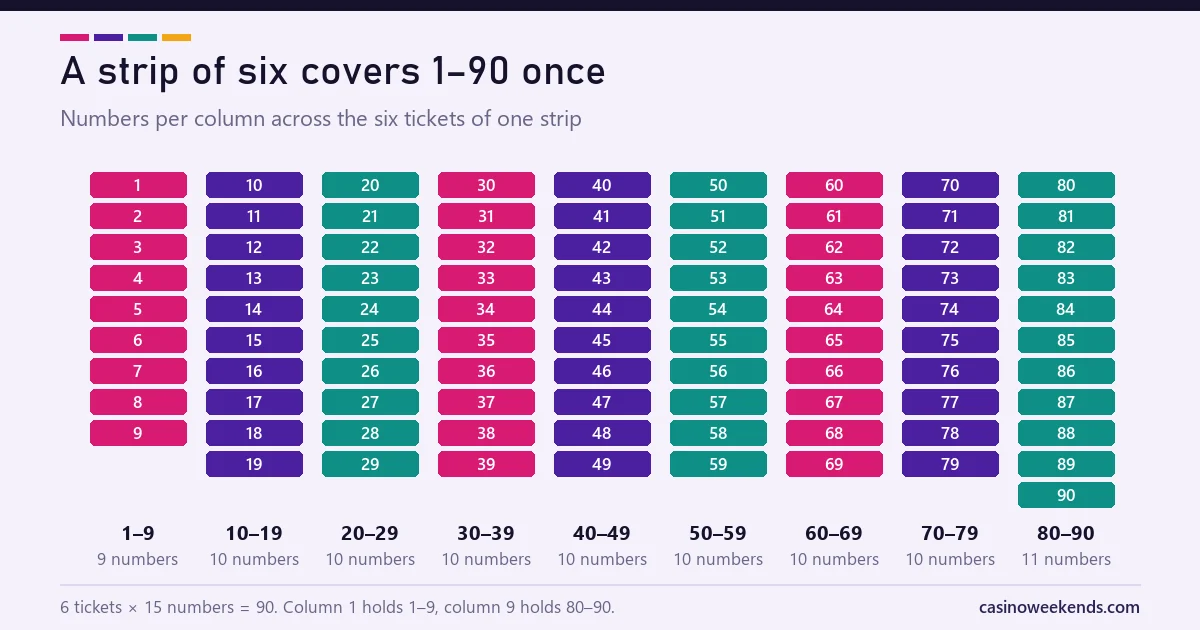
A UK 90-ball bingo ticket holds 15 numbers out of 90. That means five of every six calls will miss it. A strip of six is built so that the six tickets between them carry every number from 1 to 90 once each. Buy the strip and every single call marks one of your tickets. This guide covers how the strip is put together, what it does and doesn't change about your chances, and when it is the better buy.
On this page7 sections
How a 90-ball ticket is laid out
A 90-ball ticket is a grid of three rows and nine columns. Each row has five numbers and four blanks, so a ticket carries 15 numbers. The columns run by tens:
| Column | Numbers | How many |
|---|---|---|
| 1 | 1–9 | 9 |
| 2 | 10–19 | 10 |
| 3 | 20–29 | 10 |
| 4 | 30–39 | 10 |
| 5 | 40–49 | 10 |
| 6 | 50–59 | 10 |
| 7 | 60–69 | 10 |
| 8 | 70–79 | 10 |
| 9 | 80–90 | 11 |
The first column is one short because there is no zero. The last column has one extra because 90 sits there with the eighties. Each game has three prizes: one line (any row complete), two lines (any two rows on the same ticket) and the full house (all 15 numbers).
What makes a strip of six
A strip is six tickets printed, or generated online, as one set. The 90 numbers are split across the six tickets with no number repeated. That works out because 6 × 15 = 90. Column by column, the six tickets share the nine numbers of the first column, the ten of each middle column and the eleven of the last.
Three things follow from this:
- Every call is yours. Whatever number comes out, exactly one of your six tickets has it.
- Your tickets can never share a number. Two of your tickets will never race each other towards the same line.
- Exactly one of your tickets is closest to the full house at any moment, or several are tied. With six random single tickets you could end up holding near-copies of each other.
Does a strip improve your odds?
Per ticket, no. Each ticket in a strip has the same 15-numbers-out-of-90 shape as any other ticket. The chance that any one ticket finishes by a given call doesn't depend on which strip it came from. If 600 tickets are in play and you hold six, you hold 1% of the tickets, strip or not. On average that is still 1% of the wins.
What the strip changes is how your wins are spread. With six independent single tickets, two of them can sit on the same numbers. That raises your chance of winning a prize twice on one call (a shared prize with yourself). It also lowers your chance of having at least one live ticket in contention. A strip spreads your six tickets across the whole drum. You are more likely to have some ticket close to finishing, but less likely to have two finish together.
For most players that is the better shape. Where a room splits a shared prize per ticket, two of your own tickets finishing together mostly means splitting a prize with yourself. Our guide to how bingo prizes are split covers the rules.
How long a game lasts with one ticket and with a strip
We ran a simulation of 90-ball games and recorded the call on which a full house first landed:
| Tickets in the game | Average call of the first full house |
|---|---|
| 1 | 85.3 |
| 6 (one strip) | 77.5 |
| 60 | 68.5 |
| 300 | 62.3 |
| 1,200 | 57.4 |
A single ticket on its own needs, on average, more than 85 of the 90 balls to finish. That's why a lone ticket feels so slow. A full strip on its own finishes eight calls earlier, because six tickets are racing instead of one. In a real room the game ends when the fastest ticket in the whole room finishes. With hundreds of tickets in play, that usually happens in the low sixties. For the odds of finishing within a fixed number of calls, see call-limit jackpots.
Strip or singles: a quick decision guide
- Buying six tickets anyway? Take the strip where the room sells it at the price of six singles: it avoids overlapping tickets.
- Buying one to three tickets? The strip question doesn't arise. Your share of the room, and so your expected return, depends only on how many tickets you buy compared with everyone else. Our explainer on your share of the room goes through it.
- Playing a room with a full-house jackpot on a call limit? A strip gives you six independent shots at the limit, the same as six singles. Again, no edge, only a cleaner spread.
One practical point: online rooms often sort your tickets by the to-go count, so the ticket nearest to winning sits at the top. With a strip, the numbers on that leading ticket change hands throughout the game. That's normal. Our guide to 1TG and 2TG explains what the counter means.
Where 90-ball fits among the bingo formats
The 90-ball game is the British and Irish standard. American 75-ball and the 80-ball format use different cards and different winning patterns, and there is no strip-of-six equivalent in those formats. The comparison of 75-ball, 80-ball and 90-ball bingo covers the cards side by side. You can compare UK rooms on our bingo sites page and the bingo apps guide.
Key points
- A 90-ball ticket has 15 numbers in a 3 × 9 grid. Columns run by tens, with 1–9 first and 80–90 last.
- A strip of six covers all 90 numbers exactly once, so every call marks one of your tickets.
- Per ticket, a strip has the same odds as six single tickets. It changes how your chances are spread, not their total.
- In a busy room the first full house typically lands in the low sixties. A lone ticket needs about 85 calls.
Bingo is a game of chance. Set a budget before the session starts and treat tickets as the cost of the entertainment.