Roulette has a reputation for being complicated, with dozens of bet types and a table full of numbers. The arithmetic behind it is the opposite. On a single-zero wheel, almost every bet costs exactly the same on average. On a double-zero wheel, almost every bet costs the same higher amount, with one well-known exception. Here are the payouts and the house edge for each bet, and the one rule that cuts the cost of even-money bets in half.
On this page6 sections
Payouts on every standard bet
| Bet | Numbers covered | Pays |
|---|---|---|
| Straight up | 1 | 35 to 1 |
| Split | 2 | 17 to 1 |
| Street | 3 | 11 to 1 |
| Corner | 4 | 8 to 1 |
| Six line | 6 | 5 to 1 |
| Dozen or column | 12 | 2 to 1 |
| Red/black, odd/even, 1–18/19–36 | 18 | 1 to 1 |
The payouts are set as though the wheel had only 36 numbers. A straight-up bet covering 1 of 36 numbers paying 35 to 1 would be a fair bet. The zero, and on American wheels the double zero, is the casino's margin.
House edge on each wheel
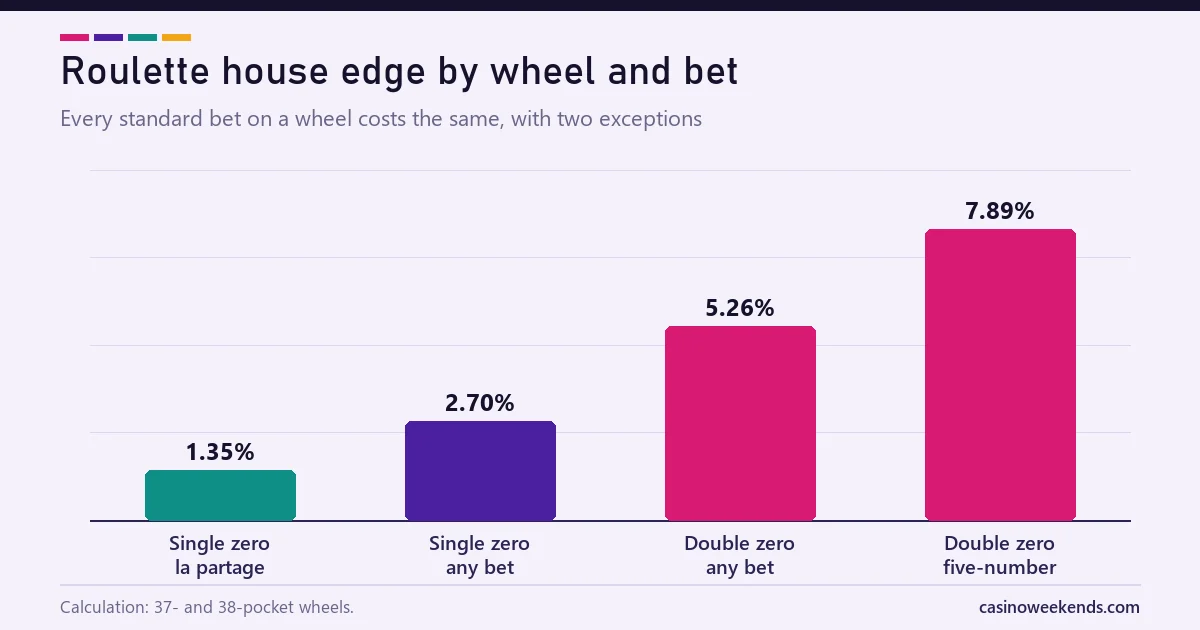
European, single zero (37 pockets). For any standard bet, the house edge is 1 ÷ 37 = 2.70%. A straight-up bet wins 1 time in 37 and pays 35 plus the stake back: 36 returned for 37 staked. A red bet wins 18 times in 37 and returns double: again 36 for 37. Every bet in the table costs 2.70%.
American, double zero (38 pockets). For any standard bet the edge is 2 ÷ 38 = 5.26%, nearly double the European figure.
The five-number exception
American tables have one extra bet: the five-number bet, sometimes called the "top line" or "basket". It covers 0, 00, 1, 2 and 3 and pays 6 to 1. It wins 5 times in 38 and returns 7 per win, so 35 is returned for every 38 staked. That is a house edge of 3 ÷ 38 = 7.89%, the worst standard bet in roulette and half as costly again as any other bet on the same table.
La partage and en prison
Some single-zero tables, often labelled French roulette, apply la partage. When the ball lands on zero, even-money bets lose only half their stake. Since zero comes up once in 37 spins and costs half a stake instead of a whole one, the house edge on even-money bets halves to 1.35%. En prison is a similar rule. The even-money bet is held for the next spin instead of losing half, and the edge is about the same. Neither rule changes other bets. Straight-ups, splits and dozens remain at 2.70%.
| Wheel and bet | House edge | Expected cost per £100 staked |
|---|---|---|
| Single zero with la partage, even-money bets | 1.35% | £1.35 |
| Single zero, any standard bet | 2.70% | £2.70 |
| Double zero, any standard bet | 5.26% | £5.26 |
| Double zero, five-number bet | 7.89% | £7.89 |
What betting systems can't change
Because every bet on a wheel has the same edge, no combination or sequence of bets can change the average cost. A system can only change how wins and losses are spread over time. The Martingale, which doubles after each loss, wins small amounts often and very occasionally loses heavily. Nine losses in a row on an even-money bet happen with a chance of about 0.248% per series on a European wheel and about 0.31% on an American one. After nine losses from a £1 start, £511 has been lost and the next bet in the series has to be £512, to win back a profit of £1. See our guides to the Martingale and the Labouchere method for how those sequences play out.
Key points
- Single zero: every standard bet carries a 2.70% house edge.
- Double zero: every standard bet carries 5.26%, except the five-number bet at 7.89%.
- La partage or en prison halves the edge on even-money bets to about 1.35%.
- Betting systems change how results are spread, never the average cost.
Roulette variants and where to play them are covered on our roulette page and live casino guide.