A full house is called and the chat fills with congratulations to three names at once. Three tickets finished on the same number. Who gets what? It depends on the room's split rule. The difference between the two common rules can be large when one player holds several of the winning tickets.
On this page5 sections
The two ways a prize can be split
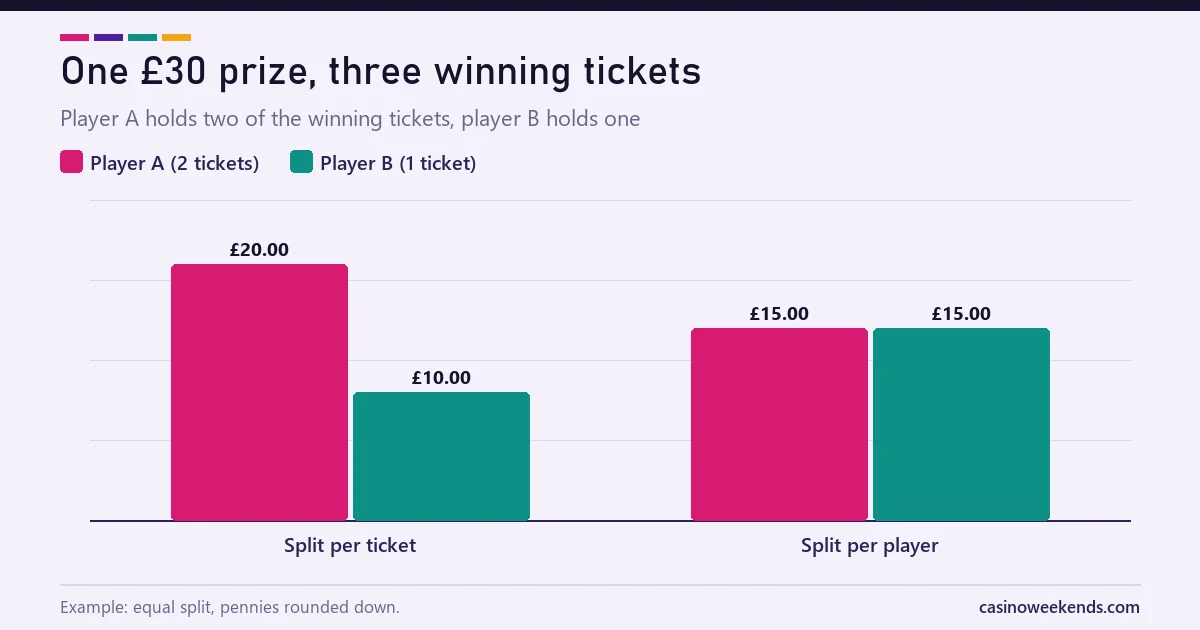
Per winning ticket. The prize is divided equally by the number of tickets that won on that call. A player holding two of the three winning tickets takes two thirds. Room rules that say a prize is "shared equally between all winning tickets" mean this.
Per winning player. The prize is divided by the number of people who won, however many winning tickets each holds. Two of three winning tickets then earns the same share as one. The wording to look for is "shared between all winning players".
| £30 prize, winners on one call | Per ticket | Per player |
|---|---|---|
| Player A, 2 winning tickets | £20.00 | £15.00 |
| Player B, 1 winning ticket | £10.00 | £15.00 |
Neither rule is "fairer" in every case. Per ticket rewards the money a player put in. Per player stops one heavy buyer taking most of a shared prize. What matters is knowing which one applies before you buy.
Where to find the rule
The split rule sits in the room's own rules or the bingo terms, not in the general casino terms. Look for wording like "prizes will be shared equally between all winning tickets" or "…between all winning players". If the room has a progressive or call-limit jackpot, check that too. Jackpots sometimes have their own split rule, and some are paid only to a ticket that wins alone.
Pennies are usually rounded down in a split. On a small prize split many ways, the rounding can visibly trim each share. A 50p one-line prize split three ways pays 16p each, not 16.67p.
How often prizes are shared
Shared prizes are more common than many players expect, especially for the one-line prize, which lands early while most tickets are still in play. Our simulation of 90-ball games found the first line arrived around call 64 with a single ticket, but around call 31 with 60 tickets in play and around call 24 with 300. The busier the room, the earlier the call. And the more tickets are sitting one number away, the more likely two of them finish together.
The full house is shared less often, because it takes far more numbers and the leading tickets are more spread out. In a busy room it is still not rare.
What it means for buying tickets
- In a per-ticket room, holding several tickets that finish together just means splitting the prize partly with yourself. You don't lose anything, but you don't gain from the extra ticket on that call either. A strip of six makes it impossible for two of your tickets to share a number, so it avoids most of these self-splits.
- In a per-player room, extra tickets that finish on the same call as your other ticket are worth nothing on that call. Buying many tickets is less efficient there. The general maths of your share of the room already says extra tickets don't change the expected return. A per-player split pushes it slightly against the heavy buyer.
Key points
- A per-ticket split divides a shared prize equally between the winning tickets.
- A per-player split gives one share to each winner, whatever their ticket count.
- The rule is in the room or bingo rules. Jackpots may follow their own rule.
- One-line prizes are shared more often than full houses, especially in busy rooms.
To compare rooms, see our UK bingo sites and bingo apps pages.